


Table of Contents
- Quick Takeaways: Cabo Real Estate Closing Costs at a Glance
- Securing Luxury in Baja: Preparing for 2026 Closing Costs
- Expertise and Authority: The Oppenheim Group Cabo Standard
- Important Transactional Disclosure
- Los Cabos Property Acquisition Tax ISAI
- The Notary Public Fees
- Fideicomiso Setup and Annual Bank Trust Fees
- Title Search Appraisals and Certification Fees
- Escrow and Closing Coordination Fees
- The Oppenheim Advantage: Navigating Mexican Law vs US Expectations
- Frequently Asked Questions About Buying Property in Los Cabos
- Limitations and Transactional Alternatives
- Secure Your Cabo Investment with Elite Representation
Quick Takeaways: Cabo Real Estate Closing Costs at a Glance
- Cabo real estate closing costs 2026 are the sum of several itemized government and service fees described below.
- Average closing costs for foreigners in Los Cabos are traditionally paid entirely by the buyer, unlike in the US where costs are often split.
- ISAI (Acquisition Tax): The largest expense, representing 3% of the assessed property value.
- Notario Fees: Legally mandated government representatives whose fee scales with the property’s value for title transfer and tax processing.
- Fideicomiso Setup: The mandatory bank trust required for US citizens buying in the restricted coastal zone.
- Certificates and Appraisals: Essential due diligence documents verifying clear title and zero outstanding debts.
- Escrow and Coordination: Third-party financial security and legal oversight during the closing window.
Securing Luxury in Baja: Preparing for 2026 Closing Costs
The Los Cabos luxury real estate market continues to attract high-net-worth buyers from the United States and Canada seeking sophisticated oceanfront estates and exclusive resort-community villas. However, acquiring a premier property in a foreign market requires absolute financial clarity and elite representation. Mexico real estate closing costs for US citizens operate under a distinctly different legal framework than domestic purchases, placing the financial burden of the property transfer squarely on the buyer.
As we navigate the 2026 legislative and economic landscape, understanding the exact mechanics of these transactional fees is paramount. Buyers must be prepared for specific municipal tax adjustments and updated bank trust regulations that directly impact their capital outlay. By mapping out these five essential fees precisely, investors can finalize their luxury acquisitions with total confidence, eliminating the risk of unexpected capital calls at the closing table.
Expertise and Authority: The Oppenheim Group Cabo Standard
Alen Fabjan, principal of The Oppenheim Group Cabo, brings 17+ years of sales experience, and the brokerage is led by Jason Oppenheim, whose firm has closed more than $3.5 billion in transactions.
Our Careful due diligence and a secure title transfer process are essential for luxury acquisitions in Los Cabos. We protect our clients’ earnest money while systematically verifying complex property histories. Transactional transparency matters as much as the property itself. We do not just facilitate sales; we engineer secure, seamless transfers of legacy assets, ensuring every peso of your closing costs is accounted for and legally optimized.
Important Transactional Disclosure
The estimated percentages and fees detailed in this guide are based on current projections for the 2026 fiscal year in the state of Baja California Sur. The U.S. Department of State’s 2025 Investment Climate Statement for Mexico describes the Fideicomiso as the way foreigners acquire use of residential property in the restricted zone, and advises due diligence because some fideicomiso arrangements have led to legal challenges.
Furthermore, US buyers must consult with certified tax professionals (CPAs) regarding IRS Form 3520 and Form 8938 reporting requirements for foreign bank trusts. The Oppenheim Group partners exclusively with certified Notarios Públicos to ensure complete legal compliance.

Los Cabos Property Acquisition Tax ISAI
The Los Cabos property acquisition tax ISAI 2026 represents the largest single closing expense, typically consuming 3% of the property’s value. Under Article 37 of the Los Cabos municipal tax law, the tax is calculated on the highest of the contract price, the cadastral value, or a commercial appraisal by a municipally authorized appraiser.
Known locally as the Impuesto Sobre Adquisición de Inmuebles (ISAI), this is a municipal tax, set in Los Cabos by the Ley de Hacienda para el Municipio de Los Cabos. In Los Cabos, the ISAI is a flat 3% of the property’s taxable value, less a small statutory deduction (Article 35, Ley de Hacienda para el Municipio de Los Cabos).
By custom the buyer pays the ISAI, though the law allows the parties to agree otherwise; the rate itself is fixed. It must be paid in full to the Notario Público before the new deed can be recorded in the Public Registry. When budgeting for a $3,000,000 oceanfront villa, buyers should allocate about $90,000 for the ISAI. Our due diligence process ensures the official appraisal (Avalúo) is conducted early, giving buyers an exact ISAI figure weeks before the final closing date.
The Notary Public Fees
When clients ask, “What are the notary fees for buying property in Cabo?”, we explain that Notario fees are set by a state-regulated tariff that scales with the property’s value. According to Mexican property law, the Notario Público is a state-appointed official carrying immense legal authority, entirely unlike a US notary public.
A Notario Público in Mexico is an experienced attorney appointed directly by the state governor. They act as an impartial legal representative of the government, tasked with authenticating documents, calculating and collecting the ISAI tax, and ensuring the legal transfer of the title. Because they are legally liable for any tax discrepancies or title errors, their fees reflect a high level of rigorous legal work.
The Notario is the central figure in the title transfer process. They draft the final deed (escritura) and formalize the Fideicomiso. While their fee tariff is regulated by the state, it scales with the property’s value, so buyers should request a written fee quote from their Notario early in the process. Attempting to bypass a top-tier Notario to save on fees is a critical error; their expertise is what guarantees your legal ownership in Mexico.
Fideicomiso Setup and Annual Bank Trust Fees
Fideicomiso setup and annual bank trust fees 2026 vary: banks quote setup and annual trust fees individually, so buyers should ask for a written quote.
The Mexican Constitution prohibits direct foreign ownership of residential real estate within the “Restricted Zone”, a designated area spanning 50 kilometers from the coast and 100 kilometers from any international border. Because all of Los Cabos falls within this zone, US citizens must use a Fideicomiso (bank trust) to safely acquire beachfront property.
In this structure, a Mexican bank acts as the trustee, holding the deed, while you (the buyer) are the primary beneficiary. You retain absolute control to sell, lease, remodel, or will the property to your heirs.
Setting up the Fideicomiso involves applying for a permit from the Secretary of Foreign Affairs (SRE), drafting the trust agreement, and paying the bank’s acceptance fee. The SRE permit fee and the bank’s setup fee are billed separately; ask for a written quote. Additionally, buyers must pay the first year’s annual administration fee upfront.
One common point of confusion is US reporting for a Fideicomiso. Under IRS Revenue Ruling 2013-14, a standard fideicomiso that only holds your property is not treated as a foreign trust, so it generally does not trigger Form 3520; confirm your own reporting obligations, especially if you rent the property, with a cross-border CPA.
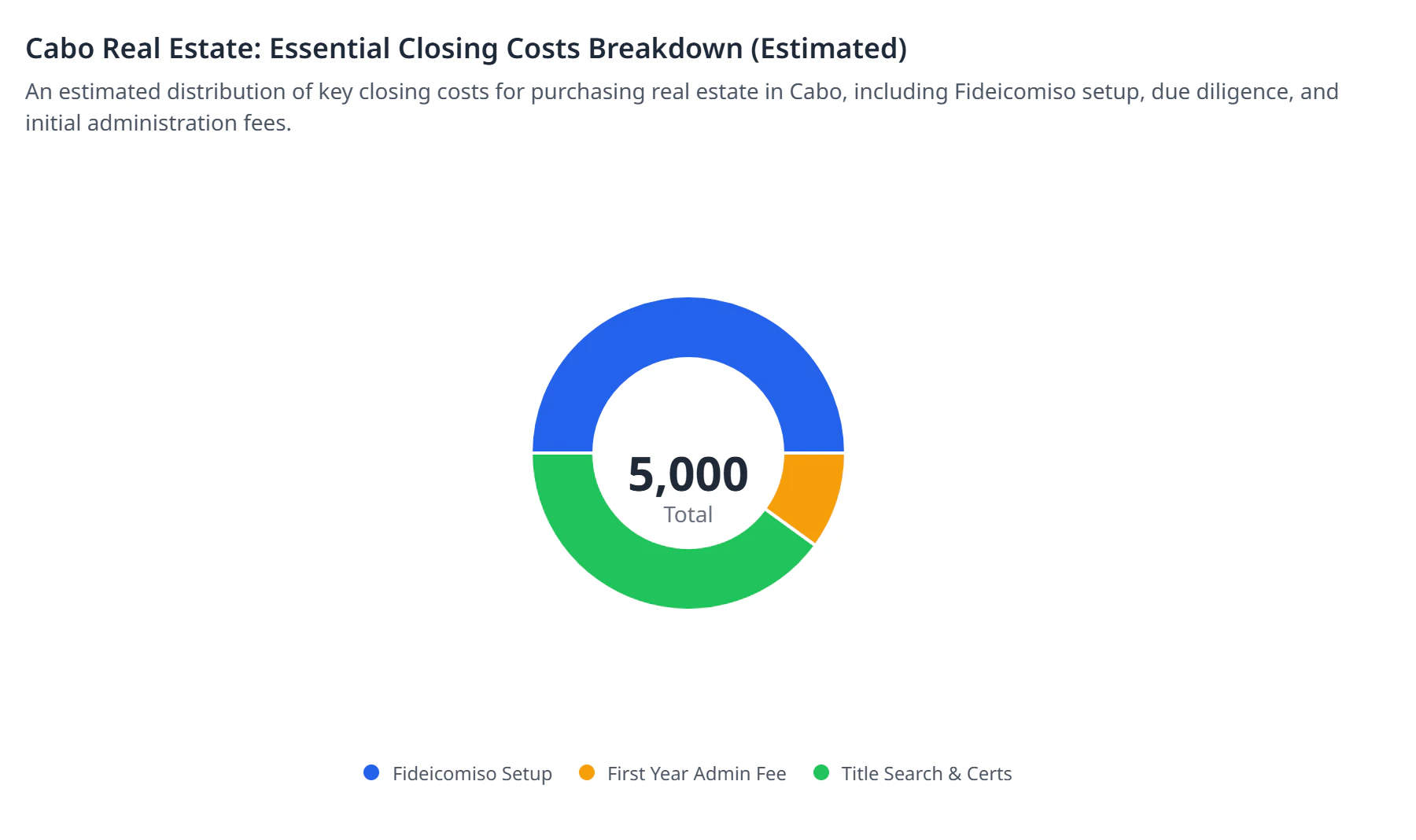
An estimated distribution of key closing costs for purchasing real estate in Cabo, including Fideicomiso setup, due diligence, and initial administration fees.
Title Search Appraisals and Certification Fees
Hidden fees when buying real estate in Cabo San Lucas often materialize during the due diligence phase; ask for written quotes on each certificate and clearance. Securing these government certificates is a standard part of a safe transfer.
During the due diligence period, several minor but essential costs accumulate. These are not arbitrary broker fees; they are hard costs paid to government offices and certified professionals to ensure the property is legally pristine.
- The breakdown includes:
- The Avalúo (Official Bank Appraisal): Required by the Notario to calculate the ISAI tax. This costs approximately $300 to $800 depending on the property size.
- Certificado de Libertad de Gravamen (Certificate of No Liens): A document from the Public Registry proving the property has no hidden mortgages, legal disputes, or liens. Cost: $100 to $200.
- Certificate of No Property Tax Debt: Verifies that all municipal property taxes (predial) are paid to date. Cost: $50 to $100.
- HOA and Utility Clearances: Letters confirming no outstanding balances with the homeowner’s association or local water/power authorities.
Sellers may unknowingly have outstanding municipal debts. By controlling the procurement of these certificates, we eliminate the “hidden fees” that often blindside unrepresented buyers at the closing table.
Escrow and Closing Coordination Fees
Average closing costs for foreigners in Los Cabos include escrow setup and legal coordination fees, which generally add $2,250 to $4,000 to the transaction. Many foreign buyers use a US-regulated third-party escrow service to hold earnest money until the notario confirms title is ready.
Unlike the United States, Mexico does not have a legally mandated escrow system natively built into its real estate framework. To bridge this gap and protect our clients’ capital, buyers can use recognized third-party escrow services (such as TLA) located in the US. These entities hold the funds securely until the Notario confirms the title is ready to transfer. Escrow setup fees usually range from $750 to $1,500.
Additionally, navigating the closing timeline requires a dedicated Closing Coordinator, typically a bilingual real estate attorney who works alongside our brokers and the Notario. They translate complex legal documents into English, ensure the Fideicomiso application stays on schedule, and review the final escritura for errors. This specialized legal coordination costs an additional $1,500 to $2,500 but is an indispensable investment in your legal security.

The Oppenheim Advantage: Navigating Mexican Law vs US Expectations
Why are closing costs higher in Mexico than the US? Mexico by custom places the acquisition tax on the buyer.
The fundamental difference lies in the legal and tax structures of the two nations. In the US, closing costs are often split between buyer and seller, with title insurance making up a significant portion of the buyer’s side. In Mexico, the seller pays capital gains tax (ISR) and broker commissions, but the buyer absorbs 100% of the acquisition tax (ISAI), Notario fees, and trust setup costs.
Can I negotiate closing costs in Cabo San Lucas? The short answer is no. You cannot negotiate government tariffs. The ISAI rate is fixed by law. However, you absolutely can negotiate the property’s purchase price to offset these costs, and in the case of a resale property, you can sometimes negotiate who pays the Fideicomiso assignment fees.
While many recommend relying on US title insurance policies adapted for Mexico, there’s a strong case for prioritizing local, boots-on-the-ground due diligence. Title insurance in Mexico covers the purchase price, not the future appreciated value.
The biggest pitfall with Mexican real estate is assuming AI tools or basic online title searches can uncover complex Ejido (communal land) histories or unregistered HOA debts. This is where The Oppenheim Group Cabo standard proves invaluable. A buyer’s attorney typically completes title and lien checks during the due-diligence period set in the purchase agreement, working to protect the buyer’s earnest money. We deploy local legal experts to manually verify the chain of title at the Public Registry, ensuring the land was legally privatized.
Furthermore, the USMCA bars expropriation except for a public purpose, on a non-discriminatory basis, with prompt, adequate and effective compensation. The U.S. Department of State – 2025 Investment Climate Statements: Mexico explicitly outlines the protections afforded to foreign investors under the USMCA (United States-Mexico-Canada Agreement).
By contrasting Mexican law with US expectations early in the process, we transform a potentially opaque foreign transaction into a predictable, secure acquisition.
Frequently Asked Questions About Buying Property in Los Cabos
Who pays closing costs in Mexico, buyer or seller?
In Mexico, the buyer pays almost all closing costs, including the acquisition tax (ISAI), Notary fees, and trust setup. The seller is responsible for paying their own capital gains tax (ISR) and the real estate agency commissions.
How much are closing costs in Cabo San Lucas on a $400,000 house?
As a dated 2026 estimate based on the components in this guide, a $400,000 property would incur a 3% ISAI tax (about $11,600 after the statutory deduction), Notary fees (~$4,000), Fideicomiso setup (~$2,500), plus additional certification and escrow fees, for an estimated total of roughly $18,100 or more.
What is the 3-3-3 rule in real estate?
Adapted for the Cabo luxury market, the 3-3-3 rule suggests taking 3 days to physically tour and select properties, 3 weeks to complete rigorous due diligence and secure escrow, and 3 months (roughly 60-90 days) to finalize the complex Fideicomiso and close the transaction.
How do Americans safely buy real estate in Cabo San Lucas?
Americans safely buy Cabo real estate by utilizing a Fideicomiso (bank trust) for properties in the restricted zone, employing a US-based escrow account to hold funds, and hiring elite representation like The Oppenheim Group to conduct thorough legal due diligence before releasing earnest money.
What is the due diligence period for buying property in Mexico?
The due diligence period is negotiated in the purchase agreement. During this window, your legal team verifies the chain of title, ensures there are no liens or unpaid taxes, and confirms the property is eligible for a Fideicomiso transfer before your deposit becomes non-refundable.
Can US citizens own beachfront property in Los Cabos?
Yes, US citizens can own beachfront property in Los Cabos, but they cannot hold the deed directly in their name. Because Cabo is within 50km of the coast, foreigners buying a home must acquire it through a fideicomiso (bank trust); a Mexican corporation can hold title in the restricted zone only for non-residential (commercial) use.
Who is the best real estate brokerage for luxury homes in Baja?
The Oppenheim Group Cabo is the Los Cabos office of The Oppenheim Group, the brokerage led by Jason Oppenheim. We combine global celebrity-tier marketing reach with a due diligence process that protects high-net-worth buyers navigating the complexities of Mexican real estate law.
Limitations and Transactional Alternatives
While overall closing costs can be significant, in practice, we’ve found that costs can vary significantly depending on the type of asset you are acquiring.
When buying pre-construction luxury condos, the closing costs are delayed until the physical delivery of the unit, which could be 18 to 24 months after your initial deposit. In these scenarios, buyers must account for potential inflation in the Notario tariffs by the time 2026 or 2027 delivery dates arrive.
Conversely, when purchasing a resale property, an alternative approach is the assignment of an existing Fideicomiso. If the seller already holds the property in a bank trust, you can sometimes assume their existing trust rather than creating a new one. This approach works well for saving 2-3 weeks of setup time, but falls short when the bank charges exorbitant “assignment fees” that negate any cost savings. We analyze both options during the offer phase to determine the most cost-effective route.
Finally, the hidden cost of financing in Mexico is a major limitation. Mortgages for foreigners carry exceptionally high interest rates and add significant origination fees to your closing costs. For this reason, many luxury buyers purchase in cash.
Secure Your Cabo Investment with Elite Representation
Understanding the fees that make up Cabo real estate closing costs 2026 is the first step in your acquisition journey. By accurately budgeting for the ISAI tax, Notario fees, Fideicomiso setup, due diligence certifications, and escrow coordination, you remove the financial guesswork from your investment. The Mexican real estate system is highly secure when navigated correctly, but it demands rigorous oversight and unwavering attention to detail. Our due diligence and transfer process ensures your capital is protected at every phase. Ready to explore the finest oceanfront estates and luxury villas in Baja California Sur? View All Properties and let our elite team guide your next legacy investment.
Written by Alen Fabjan