

The seller formally accepts and carries out the proposal to purchase the property, referred to as the “Offer to Acquire” or simply “Offer.” The buyer enters into a legally binding agreement with a neutral third party, known as the “Escrow Agent” and the “Escrow Company”, to ensure that the funds and documents related to the property purchase are securely held until all necessary conditions are met. Additionally, as per the Money Laundering Law, the buyer is required to provide copies of identification documents such as their US passport and driver’s license and fill out forms for Know Your Customer (KYC) and Privacy notices.

The buyer is required to make an initial deposit, usually ranging from $5,000 to $10,000 USD, along with an escrow fee within three business days of accepting the offer, as stated in the offer document.
The buyer’s real estate agent will then submit the fully accepted offer, escrow notification letter, identification documents of both buyer and seller, and any other necessary ownership documentation to the Closing Officer or Closing Company. Upon receiving the initial deposit, the Closing Officer or Closing Company will inform the buyer of the estimated closing costs and additional settlement requirements and provide information on how the buyer will take title of the property.
They will also work with the buyer’s legal or fiscal counsel to complete any due diligence and meet any conditions specified in the offer. The real estate agent will work with all parties, including the Closing Company, lawyers, Closing Officer, seller and buyer, to remove any contingencies, finalize inspections or inventories, and address any other issues that could delay the release of the Earnest Money Deposit.
If the buyer wishes to move forward with the purchase, the agent will provide the wire and escrow agreement for the Earnest Money Deposit. If the buyer chooses not to proceed, the agent will facilitate the refund of the initial deposit and inform the seller, canceling the transaction.

The buyer enters into an agreement with an escrow company, known as the Escrow Agreement, which is a standardized agreement. The buyer then funds the Earnest Money Deposit (EMD) as specified in the offer document. The EMD is the full amount of the deposit, minus the Initial Deposit, for example, if the EMD is $50,000 and the Initial Deposit was $5,000, the balance due is $45,000 (unless stated otherwise in the offer document). Additionally, the buyer also deposits a PRE-Closing Costs Fee, which ranges from $3,000 to $6,000 USD, and in some cases up to 50% of the total cost. This fee will be applied to the closing costs that are due at the closing of the property and will offset the costs of pre-closing permits and requirements. If the buyer fails to make the EMD, the broker will inform the real estate agent, escrow agent, buyer and seller and the buyer will have 5 days to “cure” (deposit) the funds. If the deposit is not received within the five days and no extensions have been negotiated, the transaction will be canceled with no further responsibility to the buyer, or the seller and the Initial Deposit will be returned to the buyer by the Escrow Agent.

Fourth – Title Transfer (up to 60 Days)
The buyer and seller submit all necessary documents to the Closing Company, Closing Officer, and/or Notary to complete the Transaction File, which will be submitted to the Notary and Trustee Bank. This includes all information needed to follow the established timeline. The Closing Officer, Closing Company, and/or Law Firm in charge of closing will provide the Notary and Trustee Bank with the Transaction File, which includes all requirements for the Notary to proceed with the transaction. The Associate Attorney and the Notary will be available to answer any questions from the buyer, seller, or their respective counsel at any time.
The Notary will calculate an estimate for Capital Gain Tax for the seller’s review, this is usually done before the offer is accepted. Taxes are calculated based on the value of the seller’s purchase (cost basis) and the sale price of the property, considering the estimated peso value of the USD value at closing (Capital Gain tax or ISR for 2019 is 35% of the profit or gain in pesos). The Notary’s office will prepare Trustee Bank Instruction Letters for both the buyer and seller to sign. These letters notify the Trustee Bank that the property has been sold, the terms of the sale and acquisition, the appointment of the Notary as the official overseeing the sale, and also provides a proxy for one of the Associate Attorneys in the Notary’s office to sign the deed of title on behalf of the buyer and seller at closing, so neither the buyer or seller needs to be present. These letters will be submitted to the parties with instructions on how to comply with Mexican Law, including apostilles, notary in the US, Consular Certifications, Translations, and others.
The Notary, Closing Company, or Law firm will request the Foreign Affairs Permit (FAM or SRE Permit) from the Ministry of Foreign Affairs, which is a requirement for any foreigner purchasing property in Mexico. The Notary will prepare the Deed of Title held in Trust (Trust Deed) for the Trustee Bank’s review, as well as the buyer and seller. The Trust Deed, also known as a Fideicomiso, is the ownership mechanism for foreigners (non-Mexican citizens) in Los Cabos, as well as all coastal and border areas of Mexico. The appointment of the Trustee is generally determined by the Notary and will often be the same Trustee as the seller for cost and continuity reasons. The Trustee’s only responsibility is to hold the Trust Deed on behalf of the Beneficiary Owner(s) and to act in accordance with their instructions. Property held in trust is not considered an asset of the Trustee Bank in accordance with Mexican Constitutional Law. If there is an existing Trust, then an assignment of Beneficiary Rights can be prepared. If the Purchaser is Mexican, then the cancellation of the Trust and if both are Mexican is a Deed Transfer. Upon review and acceptance of the Trust Deed, as well as closing documentation requirements, the Trustee will authorize the Notary to execute the Trust Deed with the Parties or their authorized Proxy(s).

Upon receipt of the Trustee Bank’s authorization and instructions to close, the Notary will notify the Purchaser to deposit funds into escrow within five days of the closing date or as soon as possible. The Closing Officer, company, and/or law firm will prepare a draft settlement for both parties’ review, as well as final wire instructions for the Purchaser’s final deposit. Both parties will authorize and sign the final Settlement Statement, which will be sent to the Escrow Agent. The Purchaser will fund escrow with the remaining balance of the purchase price, closing costs, and any additional fees. Once the Escrow Agent confirms receipt of the funds, the necessary documentation for transferring title will be completed, including obtaining signatures from the Trustee Bank, Purchaser, and Seller or their proxies. The Notary will submit to the Escrow Agent a copy of the executed Trust Deed, certificates of no liens and tax debt, a notice of sale filed in the public registry, and a letter confirming transfer of title. The Escrow Agent will review the documents and release all funds within two business days if all conditions in the escrow agreement are met. This transaction is now closed.

After the transfer of title is completed, the Notary will register the updated Trust Deed with the local government offices and pay all necessary taxes for both parties. Within 10-14 days, the Notary will provide the Purchaser and their representatives with a copy of the Trust Deed to assist with transferring utility contracts and finalizing club memberships. Approximately 3-4 months after closing, the Notary will issue the final closing package, which will include a certified original Trust Deed in favor of the Purchaser, a certified English translation, a summary of property and deed information, a final closing statement, and all receipts for closing expenses, fees, and taxes paid. The Notary will also provide a closing Escrow ledger to reconcile deposits. All documents will be provided in both paper and digital formats and will be sent to the Closing Officer or held for the Purchaser as requested. The Notary will also provide the Seller with a copy of all fees and taxes paid on their behalf, which can be used for credit in the US or Canada, or other treaty compliant countries, for taxes paid on foreign income earned.
The FINAL CLOSING PACKAGE provided to the Purchaser will include:
A certified copy of the registered Trust Deed
A certified translation of the registered Trust Deed
A Trust Deed Summary form, detailing important information such as the legal description, owner of record, registered value, and tax ID number
The final Settlement Statement and Escrow Disbursement Ledger, as well as any applicable refunds
Receipts for all closing expenses, such as acquisition tax, bank fees, and Notary’s fees
Copies of all prorated expenses paid, including property taxes and HOA fees
The Title Insurance Policy, if purchased
The FINAL CLOSING PACKAGE provided to the Seller will include:
A certified letter from the Notary regarding the payment of Capital Gain Tax (ISR) or any applicable exemptions
A copy of the receipt for payment of Capital Gain Tax (ISR)
A copy of the receipt for payment of any other related expenses
The final Settlement Statement
WHAT INFORMATION DO I NEED TO PROVIDE TO BUY OR SELL MY PROPERTY?
INFORMATION AND DOCUMENT REQUIREMENTS
Despite being held in trust by a Mexican authorized Trustee Bank, title can be held by Owner in nearly any manner accepted in the US; as an individual(s) in joint or separate tenancy, in an estate trust(s), in an LLC or incorporated entity, in a partnership agreement or in any combination thereof.
The requirements to complete the requisite file for the Notary, Trustee Bank, and the Foreign Affairs Ministry, however, are extensive. to companies’ confusion as compliance to it’s on foreign entities. Current Money Laundry Law requires even more.
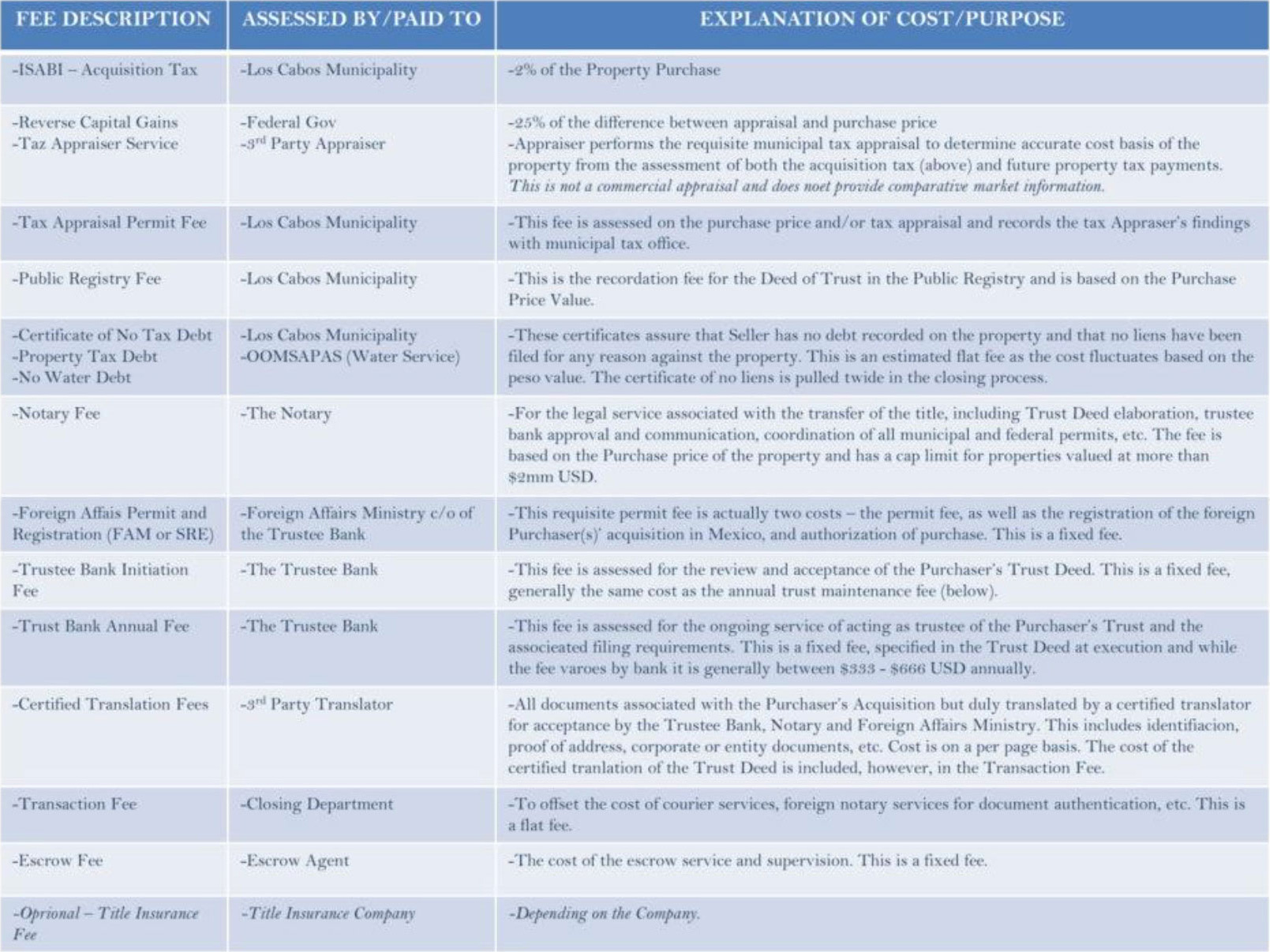
EXPLANATION OF CLOSING COSTS IN MEXICO:
Closing costs in Mexico are quite different than most of our US or Canadian Purchasers are accustomed to. Outlined below is a simple explanation of the fees associated with a cash transaction (no- financing associated with the Property).
Closing costs are always assessed to the Purchaser and unlike in the US or Canada, are not negotiated for payment by the Seller. All Closing fees paid in Mexico (with exception to title insurance and extraneous legal fees) are added to the Purchaser’s complete acquisition cost for cost basis. All taxes and fees are calculated over the peso value of the price of the property regardless of currency transacted at purchase. Any fees provided prior to closing, and until the date of payment, are subject entirely to the peso exchange rates on the date of payment and/or exchange of currencies.
What closing fees does the Seller Pay?
At settlement, Seller is responsible for:
Payment of all debt associated with the Property
Capital Gain Tax (ISR) and Filing Fees
Seller’s legal fees
Realtor’s sales commissions
Prorated fees assessed for property tax, homeowner’s associations and utilities if applicable (these items may be a credit to Seller-paid in full at closing).
How are Seller’s Capital Gain Calculated?
The Notary will calculate the Seller’s capital gain tax based on Seller’s purchase price, in Mexican Pesos, at acquisition. This information is indicated in the deed of title.
To the Seller’s original purchase price, the Notary adds to the value, the cost of any construction or remodel facturas, as well as the closing costs that the Seller paid at acquisition. After applying annual inflationary credit and construction depreciation factors, the resultant cost basis is determined.
The Notary then determines the capital gain tax (ISR) by subtracting the cost basis, as well as the sales commission from the sale price, to obtain the ‘gain’, which is taxed at 35%.