


Table of Contents
- Quick Answers: Buying Real Estate in Mexico
- Securing Your Luxury Investment in Los Cabos
- Expertise You Can Trust: The Oppenheim Group Cabo
- Important Legal and Tax Disclosure
- Demystifying the Legalities: The Restricted Zone and Bank Trusts
- The 14-Day Due Diligence Timeline: A Daily Roadmap
- Due Diligence and Closing Costs Breakdown
- Navigating Deal-Breakers: What If Red Flags Arise?
- The Role of the Notario Publico and Transferring Title
- Cross-Border Wealth Strategy: U.S. Tax Compliance and USMCA Protections
- Frequently Asked Questions About Buying in Mexico
- Financing Real Estate in Mexico: Limitations and Alternatives
- Begin Your Los Cabos Real Estate Journey
Quick Answers: Buying Real Estate in Mexico
- Foreigners can safely buy and own property in Mexico through a legally sanctioned bank trust system, with transactions typically closing in 60 to 90 days. This section summarizes the core requirements for a secure cross-border purchase.
- Yes, Americans and Canadians can legally own property in Mexico’s coastal and border regions via a Fideicomiso (bank trust).
- The standard, highly recommended due diligence period is 14 days to inspect structural, legal, and title integrity.
- Closing timelines generally take 60 to 90 days from the accepted offer to the final deed signing.
- Buyers must account for 4% to 6% of the purchase price in closing costs, largely driven by acquisition taxes and Notario fees.
Securing Your Luxury Investment in Los Cabos
Buying property in Mexico as a U.S. citizen is highly secure when utilizing a Fideicomiso and a rigorous 14-day due diligence framework. This guide details the exact timeline, legal requirements, and tax strategies necessary for a flawless transaction.
The appeal of owning a luxury vacation home or high-yield investment property in Baja California Sur is undeniable. From the dramatic cliffs of Pedregal to the pristine beachfronts of San Jose del Cabo, the lifestyle and appreciation potential are unmatched. However, navigating the legal requirements for buying a home in Mexico demands elite professional guidance. Most offers on Los Cabos property include a due diligence period of up to 14 days, and this guide walks through how to use that window.

Expertise You Can Trust: The Oppenheim Group Cabo
As a luxury real estate specialist with The Oppenheim Group Cabo, Alen Fabjan brings elite-tier representation to the Baja California Sur market. With billions in closed luxury sales globally, our brokerage combines international celebrity-tier marketing reach with hyper-local legal expertise.
We specialize in navigating the Fideicomiso process and protecting high-net-worth clients from hidden liabilities. Our Cabo team rigorously vets every property through a specialized legal lens. We ensure that your luxury retreat remains a performing asset rather than a legal burden.
Important Legal and Tax Disclosure
Cross-border real estate investments require compliance with both Mexican property law and United States federal tax regulations. International tax treaties and local zoning ordinances change over time.
This guide provides a comprehensive overview of Mexican real estate processes but does not constitute formal legal or financial counsel. We strongly advise readers to consult with licensed cross-border tax attorneys and Certified Public Accountants prior to transferring funds. The Oppenheim Group Cabo partners directly with vetted legal professionals to ensure your specific transaction meets all current US-Mexico compliance standards.
Demystifying the Legalities: The Restricted Zone and Bank Trusts
Foreign nationals acquire coastal property safely through a Fideicomiso, a legal trust mechanism established by the Mexican government. Understanding these legal frameworks is the first step to a secure investment.
The Restricted Zone Explained
The Mexican Constitution defines the “Restricted Zone” as any land within 50 kilometers (31 miles) of the coastline and 100 kilometers (62 miles) of international borders. Foreigners still cannot hold direct title in these areas; instead, they buy through a Fideicomiso (bank trust). For a comprehensive overview of how this integrates into the broader purchase timeline, Understanding the Real Estate Buying Process in Mexico outlines the exact legal milestones required.
What is the Fideicomiso Process in Mexico?
A Fideicomiso is a 50-year renewable bank trust where a Mexican financial institution holds the deed, but the foreign buyer is the designated primary beneficiary. As beneficiary, you hold the rights to use and dispose of the property: you can sell, lease, renovate, or will the property to your heirs. The bank acts merely as a trustee to satisfy the constitutional requirement.
Is Buying Property in Mexico Safe for Foreigners?
Yes, buying property in Mexico is safe for foreigners when executed through proper legal channels. The trust system is heavily regulated by the Mexican government, and the banks managing these trusts are legally obligated to protect the beneficiary’s interests.
The 14-Day Due Diligence Timeline: A Daily Roadmap
This timeline secures your capital.
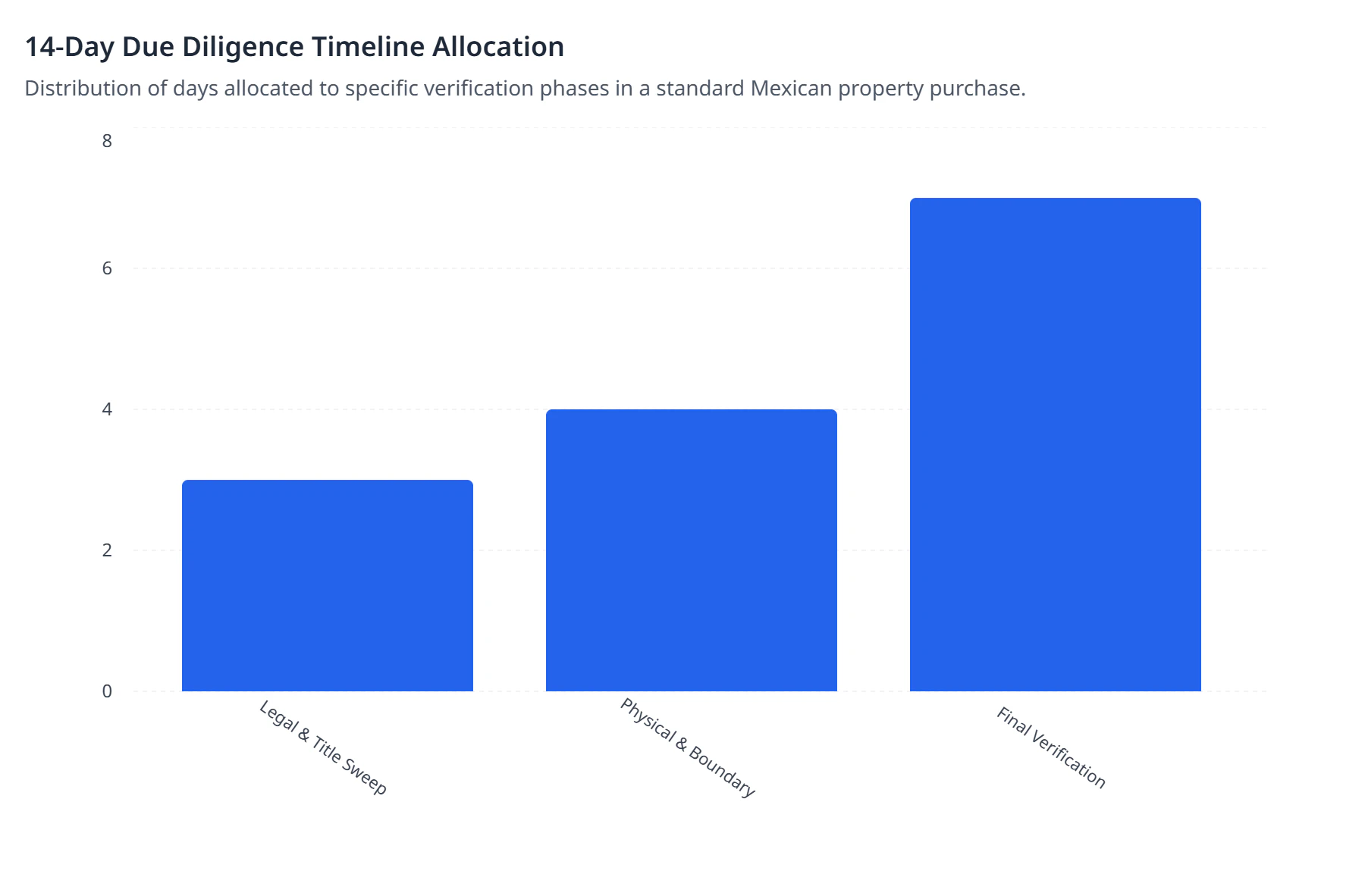
Distribution of days allocated to specific verification phases in a standard Mexican property purchase.
Days 1-3: Initial Legal & Title Sweep
The moment your offer is accepted, your attorney requests the Certificado de Libertad de Gravamen (Certificate of Freedom from Liens). This critical document confirms the seller is the legal owner and that no undisclosed mortgages, tax debts, or labor liens are attached to the property. We also verify that the current Fideicomiso (if applicable) is in good standing and eligible for transfer.
Days 4-7: Physical Inspections and Boundary Surveys
Unlike the U.S., Mexico does not mandate seller disclosure reports. We immediately dispatch licensed structural engineers to assess the foundation, electrical grids, plumbing, and roof integrity. Simultaneously, a topographer conducts a boundary survey to ensure the physical walls match the recorded deed. This prevents future disputes with neighbors or municipal authorities regarding lot lines.
Days 8-10: HOA, Utilities, and Zoning Review
Luxury communities in Los Cabos often have stringent Homeowner Association (HOA) regulations. We audit the HOA financials to ensure no special assessments are looming and verify that the seller’s dues are current. Additionally, we check utility accounts (water, electricity, internet) for outstanding balances, as utility debts in Mexico stay with the property, not the individual.
Days 11-14: Finalizing Reports and Contingency Sign-offs
During the final 72 hours, our team compiles the structural, legal, and financial findings into a comprehensive Due Diligence Report. You will review this with your agent and attorney. If the property passes, you sign the contingency removal, and your earnest money becomes non-refundable. If issues are found, we renegotiate or cancel the contract. For an alternative perspective on these steps, the guide on Buying Property in Mexico in 10 Easy Steps provides a simplified overview of the journey.
Due Diligence and Closing Costs Breakdown
Closing costs for real estate in Mexico typically range from 4% to 6% of the property’s final purchase price. This breakdown details exact due diligence fees, notary costs, and trust setup requirements.
When budgeting for your luxury investment, it is vital to separate the upfront out-of-pocket due diligence costs from the final closing costs paid at the Notario’s office.
| Expense Category | Estimated Cost (USD) | Paid When |
|---|---|---|
| Structural Inspection | $500 – $1,500 | Days 4-7 (Due Diligence) |
| Topographical Land Survey | $600 – $1,200 | Days 4-7 (Due Diligence) |
| Legal Review / Attorney Fee | $2,500 – $5,000 | Throughout Process |
| Bank Appraisal (Avalúo) | $500 – $1,000 | Prior to Closing |
| Fideicomiso Setup Fee | $2,000 – $3,000 | At Closing |
| First Year Trust Annual Fee | $500 – $700 | At Closing |
| Acquisition Tax (ISAI) | 3% of value (Los Cabos) | At Closing |
| Notario Publico Fees | 1% – 2% of value | At Closing |
The Acquisition Tax (Impuesto Sobre Adquisición de Inmuebles) is the largest single expense. This tax is assessed by the local municipality based on the appraised value of the property. Cash buyers should ensure these funds are liquid and ready to wire to the escrow account approximately two weeks before the final closing date.

Navigating Deal-Breakers: What If Red Flags Arise?
This section explains how we leverage these discoveries to protect buyers.
A standard title search may not surface communal (ejido) land issues, so ask your attorney to confirm the property’s land regime before you commit. Ejido land cannot be legally sold to foreigners without a lengthy, complex privatization process.
If our real estate due diligence checklist in Mexico uncovers unpermitted additions, unpaid HOA dues, or structural defects, you have three distinct mechanisms for resolution:
- Extend the Due Diligence Period: We draft an addendum to pause the clock, allowing the seller time to produce missing permits or documentation.
- Force a Cure or Credit: We require the seller to pay off hidden liens prior to closing, or we negotiate a reduction in the purchase price to cover the cost of structural repairs.
- Walk Away: If the title is fundamentally flawed (such as unresolved Ejido disputes), you exercise your contractual right to walk away. The escrow agency will release your earnest money deposit back to you in full, minus any minor bank wire fees.
The Role of the Notario Publico and Transferring Title
The Notario Publico handles 100% of all legal property transfers in Mexico, serving as a neutral, government-appointed official. The sale is formalized in a public deed (escritura) before the Notario, and recording that deed in the Public Registry of Property makes the transfer effective against third parties. Understanding their specific authority prevents critical delays in the closing process.
A common misconception is that a Mexican Notario is similar to a U.S. notary public. This is entirely false. In Mexico, a Notario Publico is a highly vetted, experienced attorney appointed directly by the state governor. They possess immense legal authority and bear the ultimate responsibility for ensuring the transaction is legally sound.
- The role of a notary public in Mexico real estate includes:
- Authenticating all legal documents and verifying the identities of the buyer, seller, and bank trustees.
- Ensuring the property has a clean title and that the Certificado de Libertad de Gravamen is accurate.
- Calculating, withholding, and paying the appropriate capital gains taxes for the seller and acquisition taxes for the buyer.
- Recording the final deed (Escritura) in the Public Registry of Property.
While the Notario ensures the legality of the transfer, they do not represent the buyer’s specific interests. This is why The Oppenheim Group requires our clients to retain independent legal counsel to review documents before the Notario finalizes them. For added security, we also facilitate U.S.-based title insurance through companies like Stewart Title or First American, which provides an extra layer of protection for cross-border investments.
Cross-Border Wealth Strategy: U.S. Tax Compliance and USMCA Protections
U.S. owners should confirm their IRS reporting obligations, which depend on how the property is held and whether it earns rental income. This section outlines essential asset protection strategies.
USMCA Protections Against Expropriation
Many first-time international investors worry about property seizure. However, U.S. and Canadian citizens are heavily protected under international trade agreements. According to the U.S. Department of State – 2023 Investment Climate Statements: Mexico, the United States-Mexico-Canada Agreement (USMCA) provides robust protections against direct and indirect expropriation. The Mexican government cannot arbitrarily seize foreign-owned real estate, providing a highly secure investment climate for North American capital.
IRS Reporting for Mexican Bank Trusts
What most guides won’t tell you is the hidden compliance cost of holding a bank trust. Under IRS Revenue Ruling 2013-14, a standard Mexican bank trust that only holds title to your property is not treated as a trust for U.S. tax purposes, so the foreign-trust Forms 3520 and 3520-A generally do not apply. Confirm your own filing obligations with a cross-border CPA.
If your luxury Cabo property generates rental income, that income must be reported on your U.S. tax return, though you can typically claim a foreign tax credit for taxes paid to the Mexican government (ISR).
Form 8938 and FATCA Compliance
Depending on the total value of your foreign assets, you may also trigger reporting requirements under the Foreign Account Tax Compliance Act (FATCA). This requires filing Form 8938 (Statement of Specified Foreign Financial Assets) with your annual tax return. The Oppenheim Group Cabo works alongside specialized cross-border tax planners and CPAs to ensure your luxury investment remains a performing asset, not a tax liability.
Frequently Asked Questions About Buying in Mexico
These answers address the most common concerns regarding Mexican real estate.
What is the 3-3-3 rule in real estate?
The 3-3-3 rule is a general guideline for property hunting: view 3 neighborhoods, tour 3 properties in your favorite area, and visit the property 3 different times of day before making an offer. In Cabo, this helps buyers understand sun exposure, neighborhood noise, and traffic patterns.
How hard is it for an American to buy property in Mexico?
It is not hard, but it is highly administrative. Once you establish the Fideicomiso and fund your escrow account, the process is straightforward. The complexity lies in the paperwork, which is why utilizing an experienced brokerage and bilingual legal team is essential for a smooth transaction.
Can you buy a house in Mexico for $100,000?
While you can find properties for $100,000 in Mexico’s interior or emerging rural areas, the luxury market in Los Cabos operates differently. In Pedregal, for example, the developer lists condos from $210,000 and single-family homes up to $13.5 million (retrieved September 2026).
How long can I stay in Mexico if I buy a house?
Buying a house does not automatically change your visa status. Tourists can stay up to 180 days. However, owning property above a value threshold set by Mexican immigration rules (updated annually; roughly MXN$10.8 million, about US$598,000, in 2026) can qualify you to apply for Temporary Residency via real estate investment, allowing you to stay year-round and eventually pursue Permanent Residency. Confirm the current figure with a Mexican consulate.
How long does it take to buy a house in Mexico?
From the moment you sign the accepted offer, how long does it take to buy a house in Mexico? Typically, the process takes 60 to 90 days. The 14-day due diligence period happens first, followed by the bank trust setup and Notario processing, which accounts for the remainder of the timeline.
Financing Real Estate in Mexico: Limitations and Alternatives
Understanding alternative financing prevents funding delays at closing.
While many recommend exploring local Mexican bank mortgages, there’s a strong case for alternative financing when you look at the terms. Traditional Mexican mortgages for foreigners require complex underwriting, massive down payments (up to 40%), and typically carry higher rates than U.S. financing.
- The most effective alternatives used by high-net-worth buyers include:
- Cash Purchases: The standard for luxury Baja real estate, offering the fastest closing times and strongest negotiating power.
- U.S. HELOCs: Leveraging a Home Equity Line of Credit on a primary U.S. residence to purchase the Mexican property in cash.
- Portfolio Loans: Borrowing against stock portfolios or other liquid assets through U.S. private wealth managers.
- Developer Financing: For pre-construction luxury condos, developers often offer short-term financing (e.g., 50% down, 50% paid over 24 months during construction) with 0% to low interest.
Begin Your Los Cabos Real Estate Journey
The landscape of international real estate requires precision, but the rewards of owning in Baja California Sur are extraordinary. By enforcing a strict 14-day due diligence timeline, securing a Fideicomiso, and partnering with top-tier legal experts, your investment is thoroughly protected from title defects and legal liabilities. The Oppenheim Group Cabo provides the elite representation necessary to navigate this process seamlessly. Ready to secure your piece of luxury in Mexico? Contact Our Cabo Team for a confidential consultation and bespoke property tour.
Written by Alen Fabjan